Designing Multiplexes: A Municipal Perspective (City of Burnaby)
It seems like you can’t turn around or scroll through social media for less than five minutes lately without seeing the word “multiplex” come up. While we’ve been providing design services in Metro Vancouver since 2007, and multiplexes have only been gaining traction in popularity since the introduction of Bill 44 in 2023.
Architrix’s blog series, “Designing Multiplexes: A Municipal Perspective”, will dive deeper into how different municipalities are approaching the ‘Missing Middle’ problem.
First up? Burnaby.
Our team compiled a list from publicly available data from the City of Burnaby and tallied the number of new multiplex building permits issued for project with 3 to 8 units over a 12 month period (February 2024 to January 2025).


Multiplex Issuances in the City of Burnaby (February 2024 to January 2025)
Architrix Studio Founder Khang Nguyen shared his thoughts on what this data actually means for anyone interested in building multiplexes in Burnaby:
“The Multiplex pick-up in Burnaby has been much slower compared to Vancouver – this is similar in other municipalities as well, as generally multiplex startups outside of Vancouver have seen slow starts. I suspect that this is because the profit margins are much less predictable outside of Vancouver: the potential for higher returns in Vancouver compels investors to invest where the highest return lies. One other aspect is that outside of Vancouver, buyers expect to pay less for more space thus a dense, compact unit is less desirable outside of Vancouver – at least for the time being.
As more multiplexes are completed in Burnaby, and all around BC, we will start to see what the market appetite is for them. Considering the uncertainty in the political arena currently, I feel the multiplex market won’t be as strong as it could be, at least in the short-term. But as more people immigrate to Canada, putting more pressure on the housing supply, and as the political situation stabilizes, sales will increase and investors will start to see higher returns promoting more multiplex developments.”
— Khang Nguyen
The City of Burnaby released a “Housing Design Library” in January 2025, a publicly available online gallery of pre-approved small-scale multi-unit home designs from reputable firms such as Haeccity Studio Architecture, Leckie Studio, FLUID Architecture, and Lanefab:

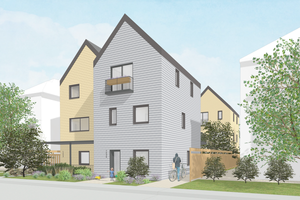


While this helps address the housing crisis to some degree, it also comes with limitations:
“The slew of standardized floorplans available is a great way for landowners and investors to see the potential of what could be done, but the use of the standardized plans as a workable building permit application set is not feasible. The variety of site conditions, end user needs, building codes, and zoning regulations from each municipality requires a knowledgeable team to provide more thorough design input and technical information to navigate the permitting and construction processes. The standardized and catalog plans available to the public provide a great starting point to envision what could be done and to get people interested and aware of the potential of their lots.”
— Khang Nguyen
With over 30,000 residential lots in Burnaby, with about 38% located within 400 metres of a frequent transit network, it can be anticipated that the data will reflect more and more multiplex development applications in the area.
Interested in seeing some of Architrix’s multiplex work? Check out our project on Prior Street, a character retention fourplex project in Vancouver.
Wood Cladding: A Sustainable (and Aesthetic) Path to Reducing Your Home’s Carbon Footprint
Wood cladding has a long and storied history in British Columbia, with heritage sites such as Irving House in New Westminster (built in 1865) still standing today. But it is far from a thing of the past. The use of wood cladding in modern architecture is essential to reducing lowered carbon footprint.
Wood should be considered as the material of choice for those considering ways to build their home more in more environmentally sensitive ways. The product is both renewable and durable in nature, and provided the exterior is well maintained over time, will prove to be long-lasting.
With multiple product options to choose from such as oak, cedar and fir, being mindful of your carbon footprint does not necessarily mean having to compromise on aesthetic design principles.
In the City of Vancouver, however, the building needs to be set far enough away from the property lines (at least 1.2 m) in order to clad the house in wood.
While wood cladding has its benefits, there can be other material options to consider with the same goal of reducing carbon footprint in mind. Brick, for instance, can also be both beautiful and environmentally-friendly, but comes at a significantly higher cost than wood.

Source: Builders from Climate Action
It can be reasonably anticipated that the province will have future regulations in place that will limit the total carbon footprint use of a home. Builders can be proactive in their approach in order to meet both legislative changes and shifting market demand in the housing market.
Companies like Carbon Wise, for example, are already providing services to calculate the carbon footprint of your home such as advising and consulting on how to save on energy costs, qualify for rebates and increase your home value – all while reducing your carbon footprint.
Using low carbon materials and building high performance shells, like Passive House or Net Zero, is critical to building a sustainable future for the housing industry.
While wood cladding is one way to reduce carbon footprint, there are other options to consider such as the insulation type, concrete mixtures, and ultimately the HVAC system and its energy source. All these considerations lead to being more aware of the carbon footprint of our housing industry. Lowered carbon footprint, and emissions policies throughout the province and across Canada are already being put in place so getting to know how to reduce our carbon footprint will be an important discipline, if it isn’t already.
Check out our past project that used wood cladding, a single-family home on Marine Dr, West Vancouver built by BCollective Homes.
Pad Mounted Transformers: Private Property, Public Problem
What is a pad mounted transformer (PMT)?
They are those big green metal (debatingly unsightly) utility boxes containing electrical equipment that changes high-voltage electricity to lower voltages. Sometimes found on public property, below the ground or on the pavement, they are also popping up on private residential properties.
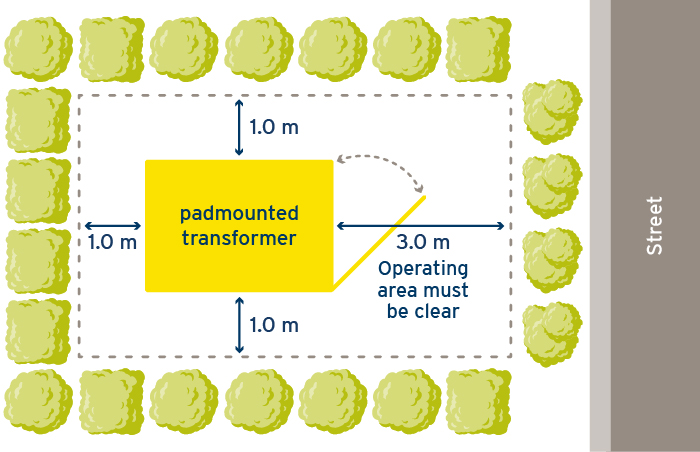
Pad mounted transformer diagram (source: FortisBC)
Vancouver’s Renewable City Strategy, first released in 2016, stated two goals for the future of electrification in the city:
- Target 1: Derive 100% of the energy used in Vancouver from renewable sources before 2050
- Target 2: Reduce greenhouse gas emissions by at least 80% below 2007 levels before 2050
These goals, while inspiring for a greener and more sustainable future, pose very present problems for homeowners and developers building new housing.
Currently, the cost to install a PMT is the responsibility of the homeowner or developer, as infrastructure upgrades are not in place with the City. This is not only a financial cost (anywhere from roughly $50,000 to $150,000) but is a loss of the Owner’s use of their own land as the minimum size of the box is 12’ x 12’.
While BC Hydro has provided some useful tips for landscaping around a PMT, it cannot ignore the aesthetic and functional limitations that the box’s presence creates.

(source: BC Hydro)
With the province anticipating over 1 million more new residents by 2050, the current infrastructure is lagging behind on both current and future electrical needs. With new Step Code upgrades for heating and hot water also coming into effect, the need to look ahead to more viable solutions is more important than ever.
What does the path forward look like for the PMT?
In our opinion the public authorities such as BC Hydro, FortisBC and the City of Vancouver should put considerable effort into finding more spaces for a sufficient volume of PMTs to meet future energy needs, such as underground, on power poles or on public property, along with absorbing some of the infrastructure upgrading costs so the burden of capital and space is not solely on the homeowner or developer with the goal of helping to reduce the cost of housing and make better use of the already limited private space.
Have a question about energy efficiency for your home?
Reach out by phone at 604. 677. 7877 or email at info@architrix.com
*As per FortisBC: Like any other piece of important utility equipment, they are locked and should be left alone – don’t let children play on or around them. If you see a transformer that is unlocked or has its doors open, note the identification number on the side and call us at 1-866-436-7847. Keep everyone a safe distance away, at least 10 metres (33 feet, about the length of a school bus).
The Search for The Missing Middle in Vancouver – Has the City Finally Found It?
Some call it “The Missing Middle”. Others might say “multiplexes”. Regardless of the name, more housing is on its way to Vancouver.
After years of study, City Council met on September 14th in relation to a report written earlier this summer. In it, a proposal was made for Council to consider several items, including:
- Allowing a larger range of housing choice within the Single family RS zones in the form of larger multi-unit buildings
- Simplify and reduce the number of zoning regulations that apply to low density (RS) residential zones; and to consolidate the nine RS residential zones (RS 1, RS-1A, RS-1B, RS-2, RS-3, RS-3A, RS-5, RS-6 and RS-7) into a single new R1-1 Residential Inclusive zone
After a Public Hearing that lasted 8 hours, Council unanimously voted to approval the proposal. Under the new R1-1 Residential Inclusive Zone, a multiplex is now permitted to include up to 6 strata units or up to 8 rental units on a 50 ft. wide lot.

Our Founder Khang Nguyen shared his thoughts on the decision:
“The decision is a small, but first step in the right direction to provide the housing needed in the city in the coming years. The policy could have done more, however, and falls short of providing a long-term and audacious path to fast and more affordable housing. The policy is a band-aid solution as a mere gesture of action. My prediction is that these units will be expensive, small, undesirable, and the years of study, not to mention cost, will have been for naught because it is too little, too late. That said I am hopeful that this strategy will evolve and adjust to meet the needs of our housing demand as it is better late than never when seeking change.”
What does this all mean for the future of Vancouver?
The City may have missed the mark on providing desirable and relatively affordable housing for their intended demographic: the middle-income, family-oriented occupant. While other cities such as Burnaby, North Vancouver and Coquitlam are offering opportunities to build housing that are less expensive or more cost-effective, Vancouver seems to fall behind on the needs of “The Missing Middle”. Parking, storage, yard space and amenities are key factors that should be considered when planning and designing a home.
The approved reduction of FSR, or floor space ratio, in single family homes also warrants further evaluation. Reducing FSR may have the potential side effect of decreasing the quantity and quality of basement suites, a significant portion of housing rental stock in Vancouver.
Only time will tell how the story of “The Missing Middle” will play out. We are hopeful that the new policy will eventually prove to be successful and with time grow into practices that are truly transformative for the City.
Architrix Studio is no stranger to multiplexes. Check out one of our completed projects, a modern duplex in the Grandview-Woodland neighbourhood at 1030 E.14th Avenue.


Images and graphics courtesy of the City of Vancouver.
Vancouver Character House and Laneway Restoration
Today, we highlight the restoration of a classic Vancouver character house, thoughtfully paired with an eco-conscious laneway home. Combining advanced technology, sustainable materials, and respect for the neighborhood’s heritage, we have crafted a harmonious living space that elegantly fuses contemporary elements and timeless appeal. Enjoy this blog post and the accompanying video rendering as we showcase our diverse projects.
The Character House Transformation: History Meets Sustainability
In the restored character house, sustainability and historical charm are seamlessly integrated. We have carefully preserved the original architectural features while meeting modern energy efficiency standards. The result is a blend of old-world charm and contemporary eco-conscious living, reflecting Vancouver’s architectural heritage.
The Laneway Home: Compact and Sustainable Urban Living
Tucked within the property, the laneway home demonstrates smart urban design and environmental stewardship. This compact space efficiently utilizes every square inch, providing a comfortable abode that coexists with its surroundings. Featuring a green roof, energy-efficient appliances, and passive solar design elements, the laneway home illustrates how sustainable living can be both stylish and functional.
Preserving Vancouver’s Architectural Legacy
This project revitalizes a classic Vancouver character house and reveals the potential for sustainable living in our city’s historic neighborhoods. By embracing modern technology and eco-friendly design principles, we can continue to cherish and preserve Vancouver’s architectural legacy.
For more details on this project head over to our Youtube channel
https://www.youtube.com/watch?v=QD38y5nry18
Design Build Trends Podcast
https://havan.ca/design-build-trends
Shou Sugi Ban
Yakisugi or Shou Sugi Ban, is a traditional Japanese method of wood preservation through surface burning. With its sleek leathered black finish, Shou Sugi Ban treated wood is a great cladding option for the rainy climate of the Pacific Northwest. Surface burning of the wood makes it more water resistant due to cell shrinkage caused by the burning process. The process is environmentally friendly and the weathering seen on exposed wood is minimized as the boards are already “weathered”. Check out our project at 3204 West 13th Ave, in Vancouver where this method has been applied. The way each board uniquely reflects light from its deep burn and two coats of sealant has this house shining as a prime example of shou sugi ban cladding done well. Or well-done depending on how you like your cladding cooked!
We’ve included a link to the official Shou Sugi Ban website for a more in depth look at different techniques you can use for Shou Sugi Ban cladding – https://shousugiban.com/category/techniques/
Secret Doors
Millwork can be used in many ways, beyond just providing storage…
In this case, a portion of a wall (right side on image) was clad in the same wood as the millwork and a hidden door was added flush to the millwork piece to conceal an ensuite in a master bedroom.
Other than allowing the Architrix Studios team to express our architectural creativity, hidden doors can evoke a sense of mystery and uniqueness in a space and be seen as a luxury addition, potentially increasing the value of a home.
Photo by Sama Jim Canzian. Architecture by Randy Bens
Rough-In Plumbing
It’s always nice when the framing and rough-in plumbing sit beautifully in the wall.
This is where the future kitchen will be in our current East Georgia house.
Modern House Tour
During the 2019 West Vancouver home tour, David came across this house, the Howard Residence by Architecture Building Culture.
Its simple mass and monolithic material choice and colour scheme stands out among the treed neighbourhood.
Hardie Façade
Check out the clean minimal look of the hardie reveal panels on one of our projects taking shape on Prince Albert street. Hardie Reveal Panel system: https://www.jameshardiepros.com/products/hardie-reveal-panel-system
Seattle Modern Home Tour
Check out this stainless steel patio edge detail for gutter and flashing #SeattleModernHomes #Contemporarydesign #modernhome #Steelfinishing